
Gypsum partition framing: studs, tracks and furring channels explained
Gypsum board walls and ceilings are quick to build, but only if you buy the right framing. Here is what each part does, in plain words.
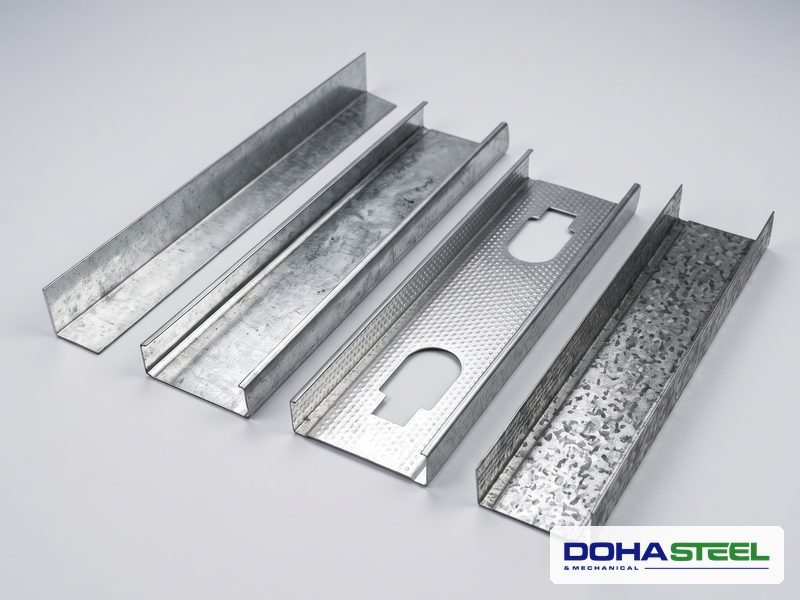
The parts
| Part | What it does |
|---|---|
| Runner track | A U-shaped channel fixed to the floor and ceiling. It holds the studs in a straight line. |
| Stud channel | The vertical members that stand inside the tracks. The gypsum board is screwed to them. |
| Main channel | Carries the frame for wall linings, bulkheads and suspended gypsum ceilings. |
| Furring channel | A hat-shaped channel fixed to block or concrete walls and soffits, so board can be screwed on with a straight, even surface. |
| L angle | Finishes the edges and corners where the board meets a wall. |
Partition wall or wall lining?
A partition wall divides a room. It uses runner tracks top and bottom with studs between them, and board on both sides.
A wall lining covers an existing wall to make it straight or to hide pipes and cables. It usually uses furring channels fixed to the wall, with board on one side only.
Matching the sizes
- Studs and tracks come in matching widths, commonly 50, 70, 75 and 100 mm. Always buy tracks the same width as your studs.
- Wider studs make a thicker, stiffer wall and leave more room for insulation or cables.
- Standard lengths are around 3 m, cut to the room height on site.
Before you buy
Bring the room length, wall height and the stud width you want. From that you can work out how many tracks and studs you need. Studs are usually spaced about 400 to 600 mm apart, so check what your board supplier or consultant recommends.
All our framing is galvanised steel, so it does not rot, warp or attract termites the way timber can.
Need a price?
Call us or visit the store at Al Najma Souq. We'll check stock and give you a price on the spot.